Only one problem, in the time since since 2010 my Icom has stopped talking to my computer. So, I need new ways to monitor radio signal strength over time. In fact since 2010 radio technology and monitoring with a computer has advanced considerably. No more need to bother with expensive stand-alone receivers that may or may not communicate with your computer. Today we live in a world of Software Defined Radio, or SDR. This puts all the tuning/monitoring/logging controls in one simple (or not) window on your screen, your computer does the heavy lifting. The interface I use is RTL-SDR Version 4. This small dongle is VERY reasonably priced and tunes from HF to UHF with proper antenna attached.
For monitoring I use the SDR# software by Airspy. It provides the controls to do everything you want which for me is fairly minimal. Once you set up the window to the frequency band you wish to monitor, logging is readily accomplished by selecting the FFT: SNL Logger from the main menu (upper left corner). Set the capture interval (in seconds) and "enable" it. It will prompt you for a file name and location and then you are cooking.
So, in order to run my experiment I need only boot up the system and record. As I planned to watch the eclipse in Austin, the equipment would have to be left running over several days on its own. As it turns out this is not so bad an option and success was granted me.
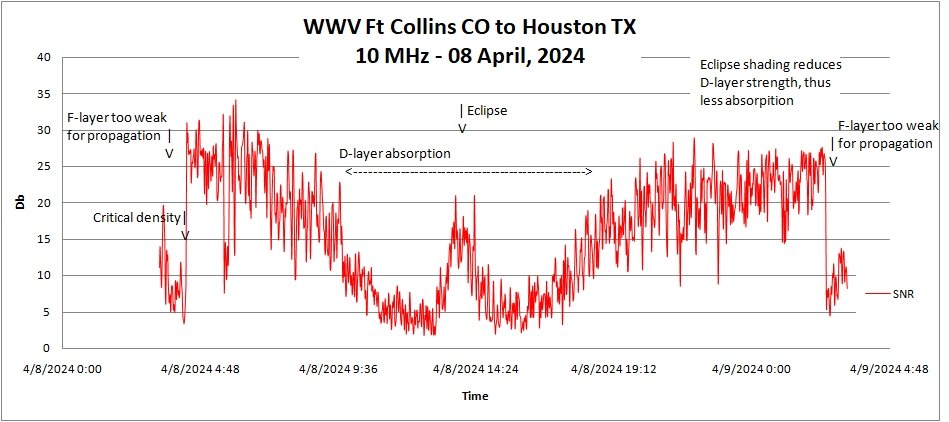
Below is the record on the day of the eclipse. Interpretation of signal strength over time is the same as always. The morning and evening sudden signals rise or fall as the ionosphere strengthens above and then dissipates below a critical density needed for propagation. A deep D-layer absorbtion at mid-day attunuates the signal making reception of Ft. Collins difficult to impossible.
In this case though there is another actor in the circuit drama. Near mid-day the moon's shadow passed across the circuit. This shading shutoff the D-layer ionization and, being the lowest of the ionospheric layers, recombination took place rapidly. With that the absorbtion was shut off and the Ft. Collins signal again managed to get through to Houston. The event was short-lived though. As soon as the shadow passed beyond the region the D layer rapidly re-ionized and signal absorbtion returned.
For the rest of the afternoon the D-layer slowly weakened as the sun passed westward. Soon the signal from Ft Collins was comming in near full strength. This continued through the later afternoon until the F-layer too began to dissipate. When the electron density finally fell below critical density the circuit shut off. What a nice story!